


2026 AI in social media marketing report: Survey stats + PDF + AI checklist
Summarize this article via
AI is now baked into social media marketing—but teams are using it in very different ways, and the “right” workflow still isn’t obvious.
We surveyed agency and in-house marketers about how AI fits into their daily social media workflow—use cases, tools, editing, outcomes, concerns, and 2026 budget direction.
Let’s begin with the key takeaways. 👇
2026 AI in social media marketing statistics: The TL;DR
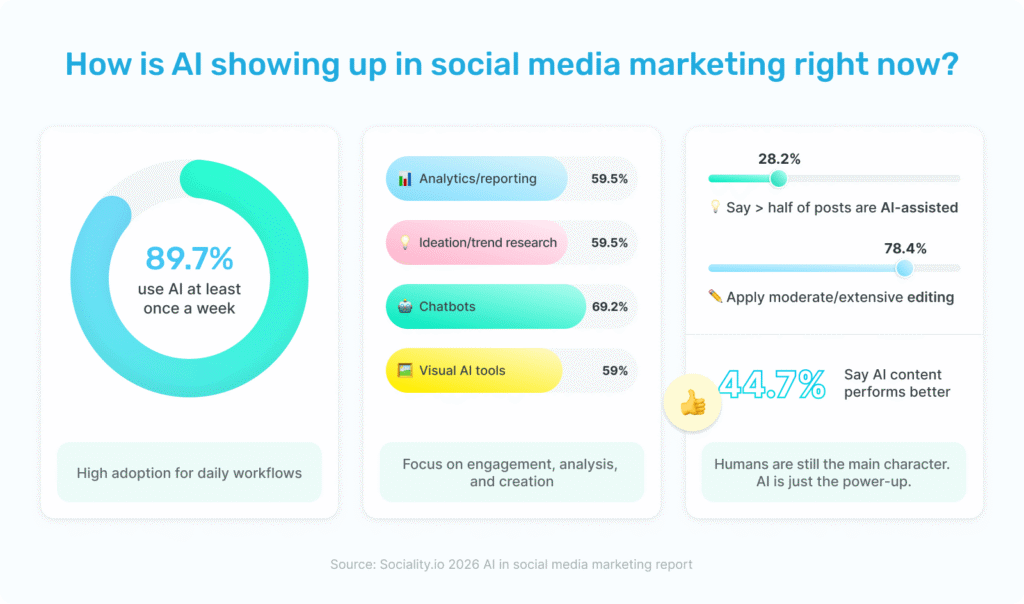
- 89.7% use AI daily or several times a week
- 59.5% use AI for analytics and reporting
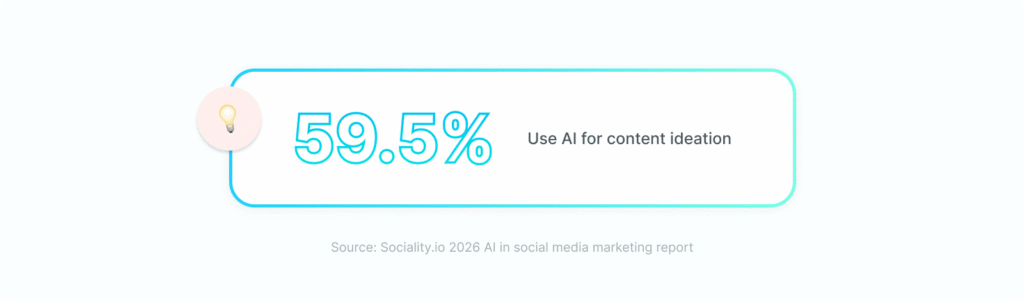
- 59.5% use AI for content ideation and trend research
- 69.2% use chatbots or conversational AI tools
- 59% use visual AI tools
- 28.2% say more than half of their posts are AI-assisted
- 78.4% apply moderate or extensive editing before publishing
- 44.7% say AI-assisted content performs better
- 71.1% report time savings as the biggest improvement
Download the 2026 AI in social media marketing report PDF. 👇
- 🌟Top AI in SMM stats
- Who did we survey?
- How often do marketers use AI?
- How is AI used in social media marketing?
- What AI tools do social teams use?
- How many AI tool types do teams use?
- How much of social content is AI-assisted?
- How much editing happens before AI-assisted content gets published?
- 🚀 Does AI actually improve social media performance?
- Benefits of AI in social media marketing
- Challenges & ethical concerns
- AI budget outlook for 2026
- AI trends in SMM: How will AI reshape social media marketing in 2026?
- 🦸 If AI could unlock one “superpower” for social media marketers…
- 1 min “Check yourself”
- Final thoughts
- 2026 AI in SMM report PDF
Who did we survey?
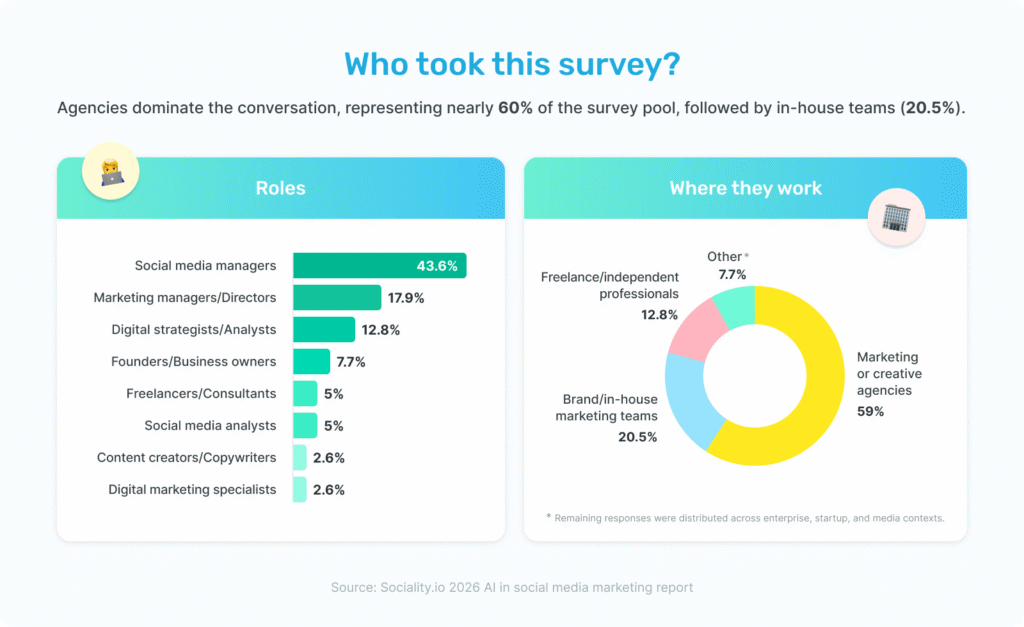
This AI report reflects the responses we gathered from social media and marketing professionals working across agencies, in-house teams, and freelance roles in our AI in social media marketing research.
Roles 👥
- 43.6% Social media managers
- 17.9% Marketing managers/Directors
- 12.8% Digital strategists/Analysts
- 7.7% Founders/Business owners
- 5.1% Freelancers/Consultants
- 5.1% Social media analysts
- 2.6% Content creators/Copywriters
- 2.6% Digital marketing specialists
Where they work 🏘️
- 59% Marketing or creative agencies
- 20.5% Brand/in-house marketing teams
- 12.8% Freelance / independent professionals
Remaining responses were distributed across enterprise, startup, and media contexts.
Company size 🫧
- 46.2% work at companies with 11–50 employees
- 23.1% work at companies with 51–200 employees
- 10.3% work at companies with 500+ employees
Remaining responses were distributed across smaller and mid-sized companies.
How often do marketers use AI?
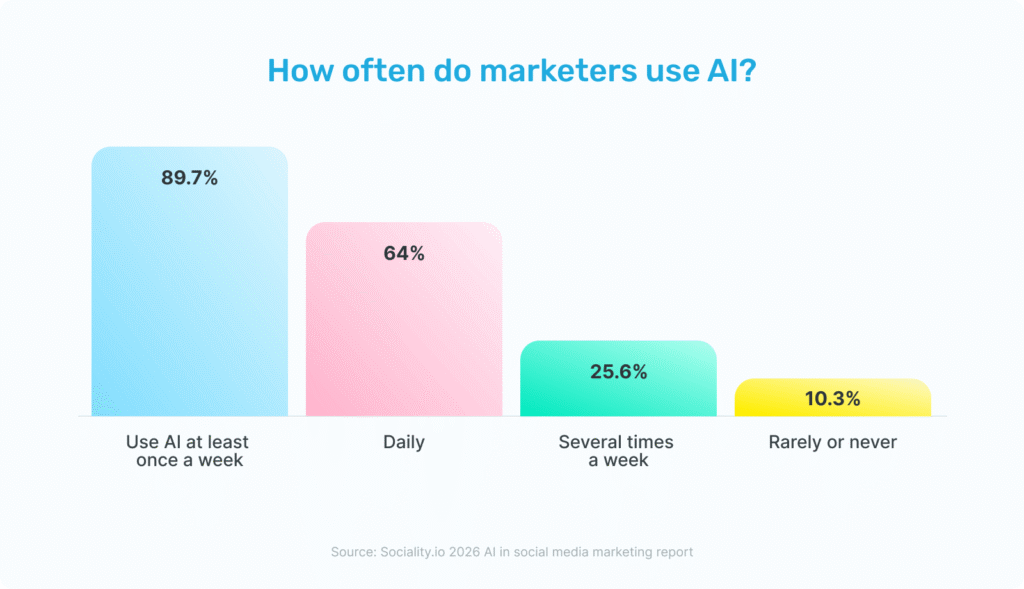
- 64.1% Daily
- 25.6% Several times a week
- 7.7% Rarely
- 2.6% Never
AI use is now firmly embedded in marketers’ weekly workflows. Nearly 9 in 10 (89.7%) use AI at least several times a week.
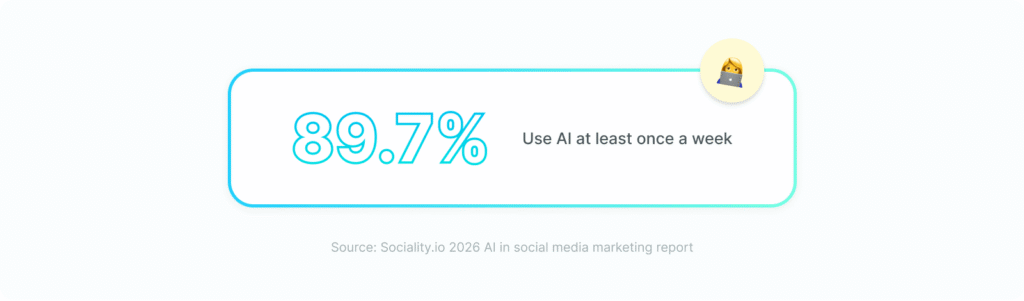
64.1% rely on it daily, signaling that it’s moved from “experiment” to “default tool” for getting work done.
Meanwhile, only 10.3% report using AI rarely or never. This smaller group typically reflects organizational friction rather than lack of interest—things like unclear usage policies, approval requirements, or compliance and brand-risk concerns.
We unpack these barriers (and how teams are addressing them) later in the report; you’ll get more AI in social media marketing stats.
How is AI used in social media marketing?
Let’s look at how AI actually shows up in day-to-day social media work.
In most teams, it’s used to move faster, reduce manual effort, and make decisions with more confidence.
Here are the main ways marketers are using AI right now (based on our survey):
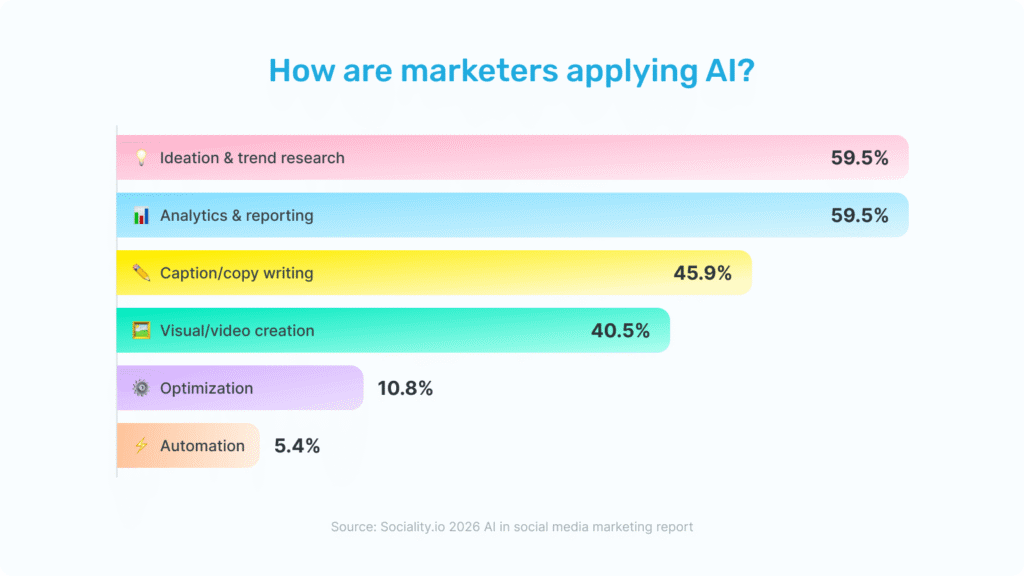
- Content ideation and trend research
59.5% of social media marketers say they use AI for content ideation and trend research. When you’re staring at an empty content calendar, AI can be a solid starting point. It helps teams brainstorm angles, generate post ideas, and explore what’s trending. - Analytics and reporting
59.5% use AI for data analysis and reporting. Reporting can take time, especially when you’re juggling multiple platforms. AI helps by summarizing performance, highlighting patterns, and turning metrics into insights you can actually use. - Writing captions and post copy
45.9% use AI for text/caption writing: first drafts, rewrites in different tones, shorter versions for different platforms, and quick variations. - Visual and video creation
40.5% of social media marketers use AI for visual/video creation. For teams that publish a lot, visuals can be a bottleneck. AI helps speed things up with quick creative directions, variations, or initial versions of visuals and video ideas. - Automation and optimization
10.8% of social media teams go further, and 5.4% use AI for automation, but this is less common. In other words, in social media automation statistics, only a small percentage of marketers use AI for this reason.
What AI tools do social teams use?
Now that we’ve covered what AI is used for, let’s look at which kinds of tools social teams actually rely on.
Because in real life, most people don’t use “one AI tool.” They use a small mix depending on the task—one tool for brainstorming, another for visuals, another for writing, and so on.
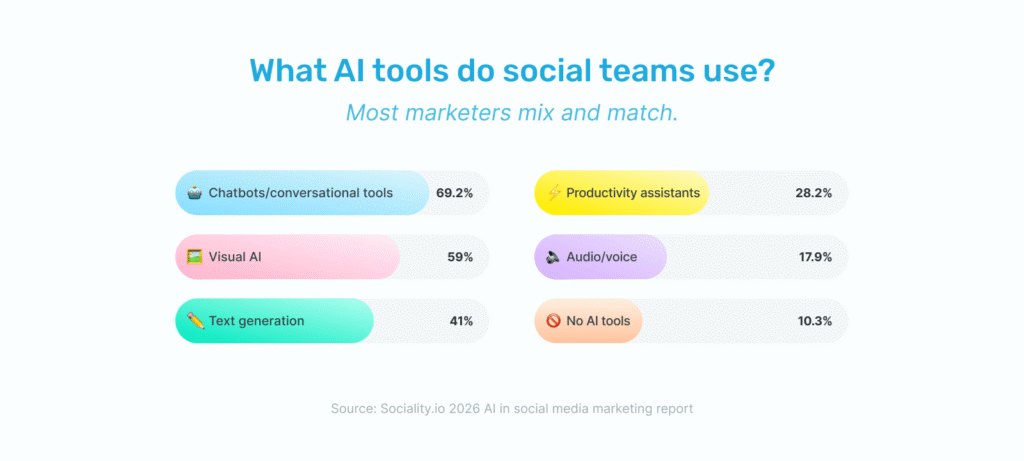
Most common tool types
- AI chatbots/conversational tools (69.2%)
- Visual AI tools (59%)
- Text generation tools (41%)
- Productivity assistants (28.2%)
- Audio/voice AI tools (17.9%)
👉 10.3% say they don’t use AI tools for social media.
Chatbots and conversational tools are the most common
The most widely used tool type is AI chatbots and conversational tools, used by 69.2% of respondents. It’s basically the “do-it-all” category that fits into almost any part of the workflow.
This is likely because chat-based tools are highly flexible and can support multiple social media tasks, including:
- Generating content ideas
- Drafting captions
- Rewriting and shortening copy
- Summarizing performance data
- Planning content themes
Visual AI tools are close behind
59% of respondents say they use visual AI tools.
These are usually used for things like:
- Generating visual concepts
- Creating quick variations
- Supporting design work when time or resources are limited
- Speeding up production for content-heavy calendars
With social platforms getting more visual every year, it makes sense that visual AI is becoming part of the standard toolkit.
💁 But use isn’t universal — generative visual ads have also faced real backlash when audiences judge them as low-quality or lacking emotional resonance.
For example, Coca-Cola’s AI-generated holiday commercials in 2025 drew widespread criticism for feeling soulless and unconnected to the brand’s traditional storytelling, highlighting that AI visuals still need careful human creative oversight.
So, the key distinction is how AI is used, I believe. Template-led, brief-driven workflows (e.g., Canva’s AI-assisted templates) and practical editing/generation tools like Google’s “Nano Banana” image generator are typically about accelerating execution with guardrails, rather than replacing the creative idea itself.
Text generation tools still matter
41% use text generation tools specifically.
Even when teams use chatbots, dedicated text tools still help with:
- Caption drafts
- Tone adjustments
- Translations
- Fast copy variations for A/B testing
Supporting tools: Assistants and audio
Beyond the core categories, teams also use:
- Productivity assistants (28.2%)
- Audio/voice AI tools (17.9%)
These are usually add-ons—not the main tools—but they’re still part of how teams speed up their work.
Not everyone uses AI tools
A smaller portion, 10.3%, say they don’t use AI tools for social media.
So while AI is already mainstream, adoption still isn’t universal—and for some teams, the barriers are still real (we’ll get into those in the concerns + challenges section).
How many AI tool types do teams use?
Marketers are moving beyond a “one-size-fits-all” approach. Only 30.8% of teams rely on a single AI tool type.
The majority have graduated to a tech stack:
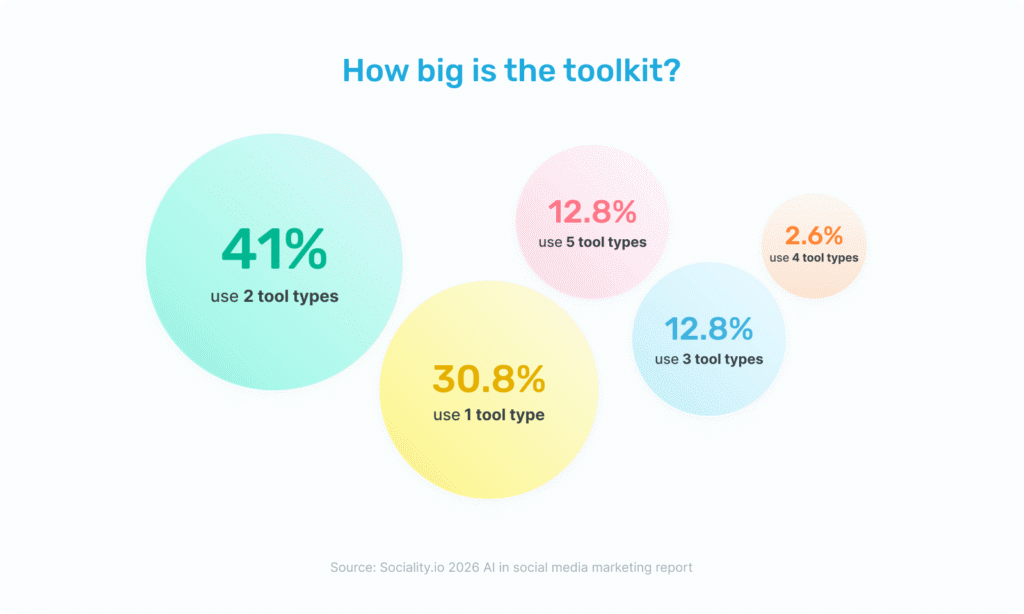
- 30.8% use 1 tool type
- 41% use 2 tool types
- 12.8% use 3 tool types
- 12.8% use 5 tool types
- 2.6% use 4 tool types
How much of social content is AI-assisted?
AI is everywhere in the workflow right now—but that doesn’t always mean it’s shaping what actually gets posted. We asked respondents how much of their social content is AI-assisted, and the answers show a pretty clear split.
Here’s what they said:
- 30.8% say AI is used in 1–25% of their posts
- 23.1% say AI is used in 26–50% of their posts
- 10.3% say AI is used in 51–75% of their posts
- 17.9% say AI is used in 76–100% of their posts
- 10.3% say they’re not sure
- 7.7% say 0% (no AI assistance)
~50% of content is AI-assisted, usually for idea generation, quick drafts, or content variations when time is tight.
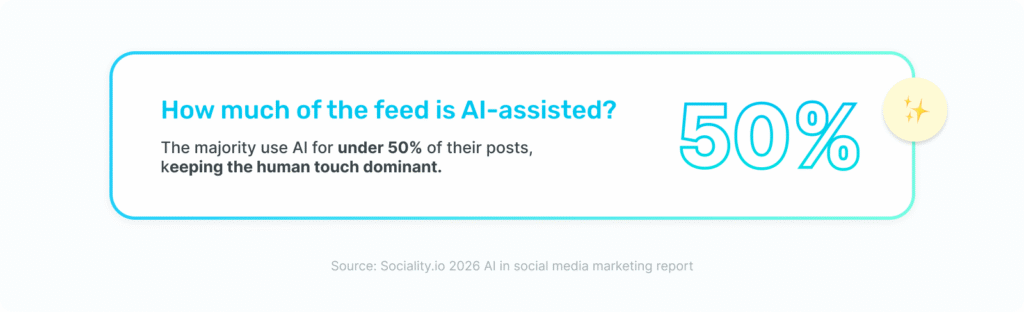
At the same time, a meaningful share is already using AI heavily. 28.2% say more than half of their posts involve AI. When you reach that level, two things tend to happen: speed goes up, and the risk of sounding generic goes up too.
The 10.3% who aren’t sure is also interesting. It often points to teams using AI in multiple small ways — but without tracking it intentionally. And once AI is part of your workflow, it’s worth being deliberate about it: what should AI touch, what shouldn’t it touch, and who checks the final version?
How much editing happens before AI-assisted content gets published?
Even with high AI use, most teams don’t publish AI output as-is. (Same here!)
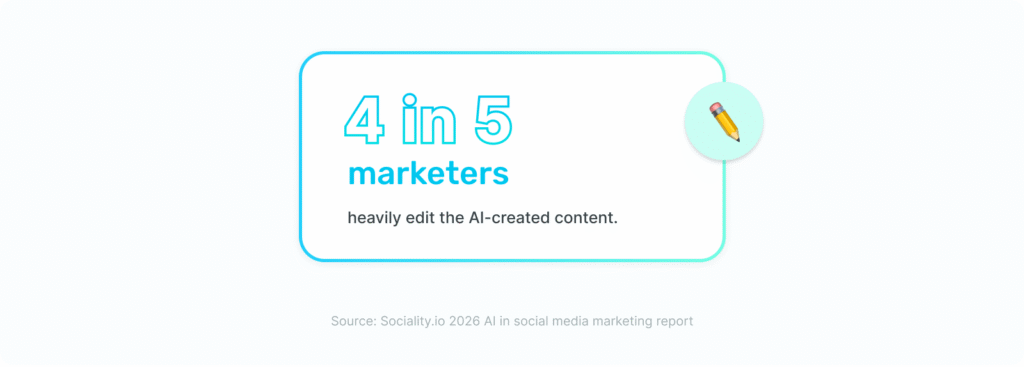
Here’s what respondents said about editing AI-generated content before publishing:
- 43.2% apply moderate editing
- 35.1% apply extensive editing
- 21.6% apply a light touch
AI is good at producing options, but social content still needs a few things AI doesn’t reliably get right on its own, like voice and tone that actually sound like the brand, cultural and platform context, accuracy, and credibility. Only with human editing does that copy not feel templated.
🚀 Does AI actually improve social media performance?
This is the part everyone wants a clear answer to, and the results are mixed (which honestly makes sense).
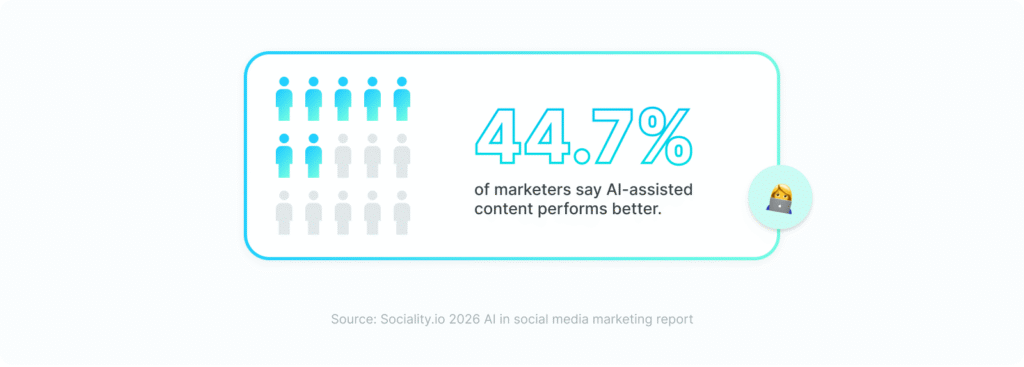
Here’s what our respondents said about AI-assisted content compared to traditional content, and our AI generated content statistics for social media:
- 44.7% say it performs better
- 18.4% say it performs about the same
- 5.3% say it performs worse
- 31.6% say they’re not sure / haven’t compared
The biggest group says “better” so AI can help teams ship faster, test more variations, and keep momentum when the calendar is full, and that often shows up in performance. This way, AI helps increase engagement on social media platforms.
At the same time, a big chunk of people aren’t sure. That alone says something: AI is already woven into the workflow for a lot of teams, but its impact isn’t always tracked as “AI vs non-AI.” It just becomes part of how the work gets done.
And “about the same” is also worth paying attention to. For many teams, AI is mainly a speed tool it helps with drafts, rewrites, and variations, but it doesn’t automatically change strategy, creative direction, or distribution. Those are still the biggest drivers of performance.
Only 5.3% reported worse results. Small, but not nothing. When AI content underperforms, it usually shows up as generic copy, repetitive phrasing, or content that doesn’t feel like the brand, which ties directly to why human editing matters so much.
Benefits of AI in social media marketing (What teams say improved)
When we asked what measurable improvements teams have actually seen, the answers were very clear: AI’s biggest impact is time. ⏱️
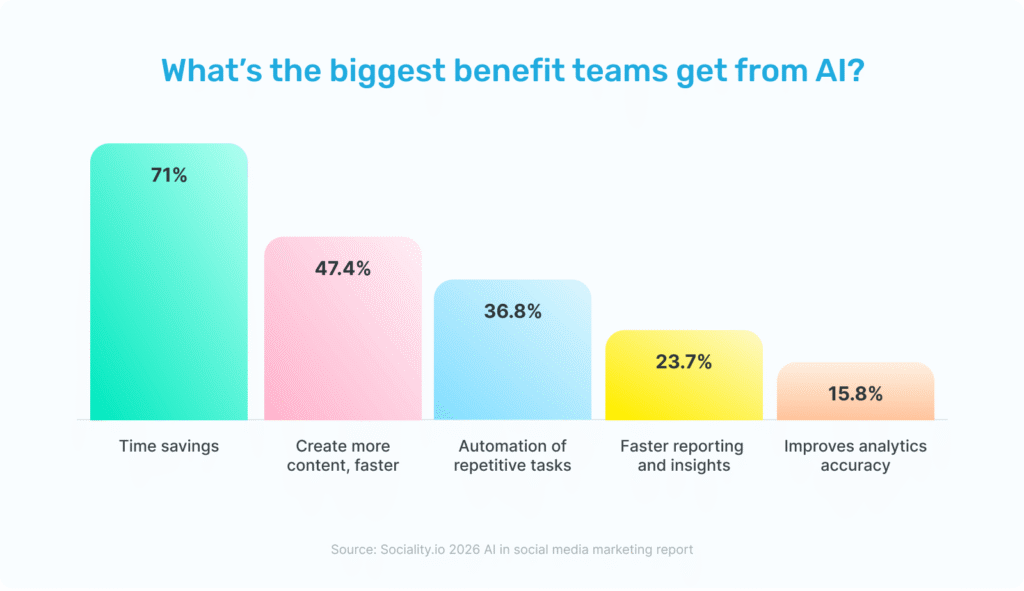
Here are the top improvements:
- 71.1% report time savings
- 47.4% say they create more content, faster
- 36.8% mention the automation of repetitive tasks
- 23.7% report faster reporting and insights
- 15.8% say it improves analytics accuracy
This is also why AI adoption keeps growing. Even if performance lift isn’t always dramatic, saving hours every week is still a big win — especially for teams managing multiple platforms, content formats, and reporting needs at the same time.
And once time is freed up, teams can invest it into the work that actually moves results:
- Creative direction
- Testing and iteration
- Community management
- Better reporting and strategy
Challenges & ethical concerns: What’s stopping teams from going further?
AI is clearly in the workflow now, but teams are still cautious about scaling it, mostly because they don’t want to trade speed for trust, originality, or brand control.
- 61.1%: Originality and plagiarism risks
- 50%: Accuracy and reliability issues
- 30.6%: Maintaining brand voice consistency
- 19.4%: Handling disclosure and transparency
Top implementation challenges
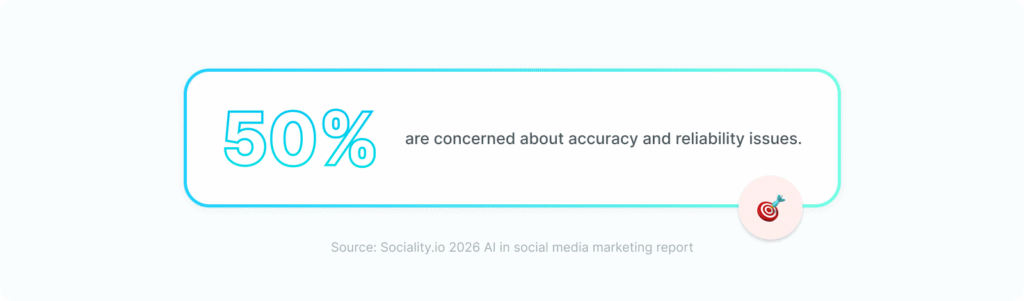
- 50% cite data accuracy/hallucinations
- 35.3% cite prompt skills
- 26.5% cite governance/compliance
- 14.7% cite training the team
But, what do these concerns mean in real social media work?
Originality/plagiarism (61.1%)
This being the top concern is very telling. On social media, “good enough” usually doesn’t win.
If AI pushes content toward the same phrases and structures that everyone else is using, brands lose what makes them recognizable. Even when the content isn’t literally copied, it can still feel repetitive, and that’s where engagement quietly drops over time.
Accuracy/reliability (50%)
AI can sound confident even when it’s wrong, and social media doesn’t give you time to recover from mistakes. If a post includes a wrong detail, a misleading claim, or a confident-sounding assumption, it can quickly turn into comments, screenshots, and trust issues. This is one of the reasons AI is often used for drafts and variations, while anything involving facts or sensitive context still needs careful review.
Brand voice consistency (30.6%)
AI can write “clean” copy, but clean is never a brand voice alone. Over time, AI-generated captions can flatten tone and make brands sound generic, especially when multiple people are using AI differently.
Disclosure/transparency (19.4%)
This one sits somewhere between ethics and brand strategy. Some brands want to be transparent and AI-forward, while others don’t want audiences questioning what’s “real.” Both approaches can work, what tends to cause trouble is inconsistency.
If audiences sense a sudden shift in tone or style, they start asking questions, even if the brand hasn’t said anything.
AI budget outlook for 2026
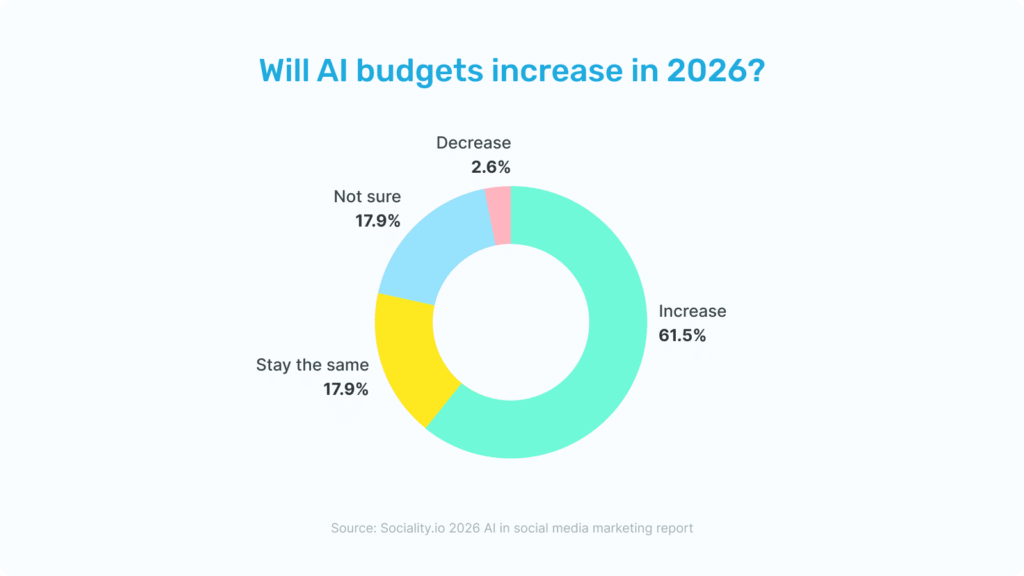
Even with those concerns, teams aren’t pulling back. In our survey, 61.5% expect their AI tools budget to increase in 2026. 17.9% expect it to stay the same, 17.9% aren’t sure yet, and 2.6% expect a decrease.
That’s a strong signal that AI is moving from experimentation to infrastructure. Teams are investing not just in tools, but in making AI use more reliable: better workflows, clearer review steps, and stronger quality control. This also matches what respondents said they struggle with — if accuracy, originality, and governance are the main blockers, then the next year of AI adoption is going to be about building systems that solve those problems.
AI trends in SMM: How will AI reshape social media marketing in 2026?
When we asked marketers how they think AI will reshape social media marketing in 2026, the answers were grounded, practical, and heavily focused on workflow evolution. The common expectation is not full automation—but faster production, smoother processes, and reduced reliance on external resources, while keeping humans firmly in charge of quality, creativity, and brand voice.
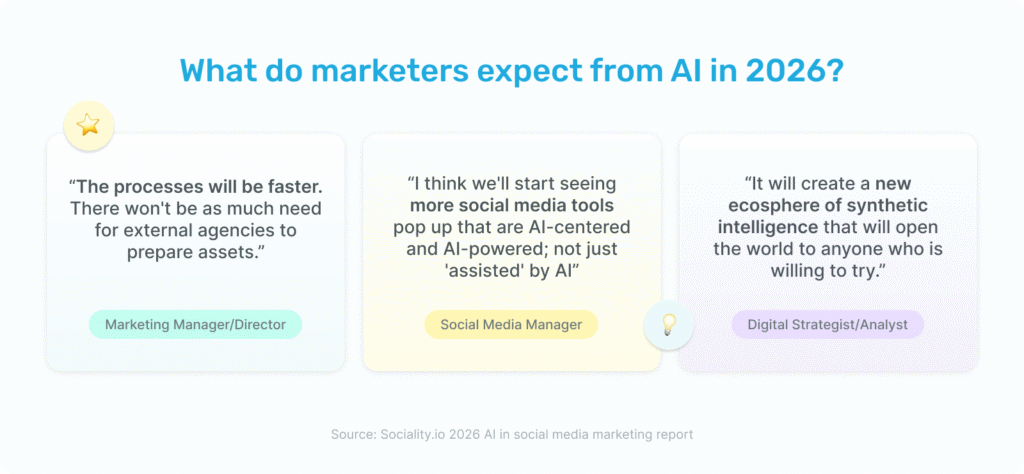
Here are predictions about the AI trends in social media marketing 2026:
The processes will be faster. There won’t be as much need for external agencies to prepare assets.
Tereza Macková
Marketing Manager for Czechia, Too Good To Go
Several respondents believe AI will move from being a supporting feature to becoming the core engine of social media tools.
I think we’ll start seeing more social media tools pop up that are AI-centered and AI-powered; not just ‘assisted’ by AI.
Kaylee Muchow
Social Media Manager, Freelancer
Others see the future as less linear, describing a constant push and pull between AI-generated content and platform-level attempts to regulate it.
Social media marketers using AI will likely see their results go thinner, as social media platforms change their algorithms to avoid AI content. On the other hand, new AI tools surface every day bringing solutions that take down barriers imposed by these platforms and laws.
Hard to say, but I picture a play-catch between the increase of AI content and the attempt to avoid it. I believe the solution is a fine balance between both.
Ana Francisco
CEO, Golden Poppy
Another recurring theme is that AI will go far beyond stock visuals and sounds, becoming a natural and frequent part of everyday content creation.
It’s a constantly evolving field, and it offers much more benefits than stock visuals and sounds. Therefore, it will be used more frequently.
Yasin Suat
Corporate Communications Supervisor, Kuveyt Türk Participation Bank Inc.
Some respondents framed AI as a strategic turning point—where efficiency increases, but trust, authenticity, and human presence become even more critical.
As AI takes its place at the center of social media marketing in 2026, while brands will seize major opportunities in terms of personalization, automation, and efficiency; they will have to build their strategies on a strong ‘AI + human balance’ due to the necessity of preserving trust, authenticity, and the human touch.
Sercan Üleş
Sr. Content & Community Manager, Kollektif Digital Advertising Agency
Finally, one perspective suggested that as the early hype fades, AI will become quieter but far more powerful and deeply integrated into daily workflows.
Since the initial excitement has passed, things like silly video edits and fake news will end, and it will start to be used truly efficiently. In the preparation of text or visual assets, it will largely render stock image sites and search engines obsolete. Still, human touch will always be needed, but it will greatly make our work easier, continue to save time, and day by day it will become more realistic, better understand and analyze prompts, and produce more accurate results.
Gül Arda
Social Media Director, Koordinat
🦸 If AI could unlock one “superpower” for social media marketers…
When we asked marketers what single “superpower” they would want from AI, the answers were less about replacing creativity and more about removing friction: reporting, personalization, consistency, prediction, and deeper audience understanding.
Pulling accurate reports easily.
Kaylee Muchow
Social Media Manager, Freelancer
Beyond reporting, marketers emphasized hyper-personalization and audience intelligence as the ultimate AI advantage.
The ability to understand each follower’s mood, interest, intent, and expectations in that moment within seconds, and to transform the same content into a different version for everyone.
Sercan Üleş
Sr. Content & Community Manager, Kollektif Digital Advertising Agency
The superpower would be hyper-personalization: AI can deliver the right content to the right person at the right time, making engagement smarter and more effective.
Can Alkanat
Jr. Strategist, Alaaddin
Brand voice consistency also emerged as a major challenge marketers want AI to solve.
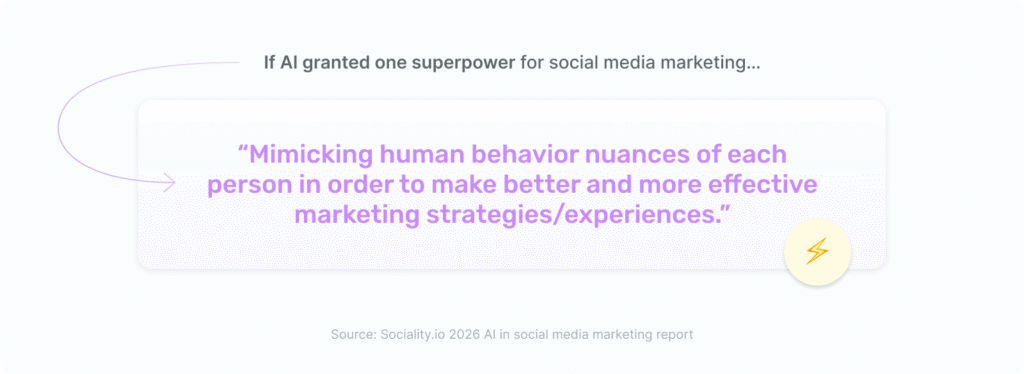
Mimicking human behaviour nuances of each person. It’s very difficult to get copy that actually reflects my writing style and tone. Even harder to maintain it.
Ana Francisco
CEO, Golden Poppy
Others described a more forward-looking “superpower”: predictive intelligence, not just content production.
It would be perfect if it could examine the last years’ trends and consumer insights deeper, and prepare the next year’s predictions in a professional way and compose these trends with your brand(s) in a unique creative approach for your audience.
Damla Artuk
Jr. Social Media Manager, Alaaddin
Some responses focused on very practical frustrations—especially the way AI tools handle credits and revisions.
When the desired result is not achieved, things like there being no credit usage for revisions, the logic of credit usage evolving into something else, or not having to start from scratch when there isn’t a result could be a superpower.
Gül Arda
Social Media Director, Koordinat
UGC was also mentioned as a clear limit of AI—where human authenticity still can’t be replaced.
UGC content performs well but still relies on humans to capture the videos.
Tereza Macková
Marketing Manager for Czechia, Too Good To Go
And finally, one respondent described a “dream scenario” that captures where AI may eventually head, even if it feels unrealistic today.
If it were to tailor the types of content users like to their liking, it could significantly increase productivity. In other words, if it were possible to instantly tailor social media content—visually, textually, and audio-wise—to the user’s preferences and make it more appealing. It’s an unrealistic expectation, but what AI is capable of today wouldn’t have seemed unrealistic if we’d heard about it before.
Yasin Suat
Corporate Communications Supervisor, Kuveyt Türk Participation Bank Inc.
What this survey suggests about AI in social media marketing
AI is already mainstream, but it’s being used in a cautious and operational way. The top use cases aren’t experimental; they’re core tasks like ideation, reporting, writing, and visuals. AI isn’t sitting on the sidelines; it’s sitting inside weekly workflows.
At the same time, the human layer still matters. Most teams are editing AI content heavily. Originality and accuracy are the top concerns. Hallucinations are the top implementation challenge. Those signals point to the same reality: the biggest barrier is not adoption, it’s trust and consistency.
So, in 2026, the advantage won’t come from simply using AI tools. Most teams already do. The advantage will come from teams that treat AI as a system: consistent prompts, voice guidelines, review steps, performance measurement, and clear boundaries for what AI can and can’t touch.
To put these findings into practice, use our AI Social Media Management playbook—it covers prompts, review workflows, and governance guardrails for social teams.
1 min “Check yourself”: Do you use AI without losing your brand soul?
- Use AI for speed, not for taste. Let it generate drafts and options, but keep the final call human.
- Build a voice bank. Collect posts that represent your best tone, and use them as examples in prompts.
- Separate low-risk and high-risk content. Drafting is low risk. Anything factual, sensitive, or reputation-related should have stricter review.
- Make editing a defined step. Not an optional habit.
- Track AI use intentionally. Otherwise it spreads everywhere without measurement, and you can’t tell what’s helping.
Final thoughts
AI is already part of how social teams plan, produce, and report. What’s still changing is how confidently teams can scale it without sacrificing what makes social content work: voice, originality, and trust.
The survey shows that most teams are using AI frequently, but they’re still editing heavily and worrying about the same issues — generic content, accuracy risks, and uneven workflows. That’s why 2026 won’t just be about “using AI more.” It’ll be about using it with a system that protects quality.
Some teams will use AI to publish more. Others will use it to publish better — faster experimentation, sharper reporting, more creative range, and quicker decision-making. That second approach is what turns AI into a durable competitive advantage.
2026 AI in SMM report PDF
Hey! Before you go, grab your 2026 AI in social media marketing report PDF. 🩵
FAQs about AI in social media marketing