

Best no-code Facebook chatbot tools for 2026
Summarize this article via
Every month, over 20 billion Facebook messages are circulated in a B2C circle. The popularity of chatbots has been growing rapidly to meet consumer demands and shifts in behaviors. Today, customers simply expect businesses to offer customer support through social media channels.
A chatbot is a programmed AI software that automatically responds to customers’ questions. It helps to optimize support and social media teams’ working time by directing them to the right information, product, or business department.
Creating a chatbot might seem stressful for those who lack coding skills and don’t have the resources to develop a new solution. To solve this problem, there are ready-to-install chatbots. This article has made a list of free and paid solutions that allow you to integrate Facebook chatbots without any coding quickly.
Define Facebook chatbot’s purpose
It is essential to define the chatbot’s purpose and prepare a list of frequently asked questions. For instance, you can share some basic information:
- Get started button
- Greeting message
- Working hours
- Location
- Contacts
- Menu
- Save user phone
- Save user email
- Quick reply
- Product gallery
Chatbots can drive customers to take action by imitating real human conversations. For example, your chatbot can explain what your company does and direct customers to the right person or department if you have a media agency. Or, if you have a restaurant, a chatbot can send a digital menu or allow them to book a table. Yes, the possibilities of chatbots can be endless, but where to start? Let’s dig into the subject.
Related article: How to Conduct a Competitor Analysis on Facebook
How to make a Facebook bot?
Choose the right platform. There are numerous free and paid Facebook Messenger chatbots, builders to choose from.
| Tool | Main channel(s) in 2026 | Free option / starting price in 2026 | Best for | Important note |
|---|---|---|---|---|
| Chatfuel | WhatsApp, Instagram, TikTok, website widget, and Facebook-related Meta automation | $69/month with a 7-day free trial | Businesses that want an AI assistant for customer replies, bookings, reminders, CRM history, and multi-channel automation | Chatfuel is now positioned more broadly than a simple Facebook Messenger bot. |
| Manychat | Instagram, TikTok, Facebook Messenger, Telegram; higher plans also include WhatsApp, SMS, and email | Free plan: 25 active contacts/month; paid plans start from $14/month, with Pro from $29/month | Creators, brands, and marketers that need social DM automation, comment replies, broadcasts, inbox tools, and AI-powered conversations | Manychat uses monthly Active Contacts limits. |
| WANotifier | WhatsApp Business API | 7-day free trial; pricing depends on contact tier + WhatsApp API messaging charges | Businesses focused on WhatsApp campaigns, Click-to-WhatsApp ads, shared inbox, auto-replies, WhatsApp Flows, drip sequences, chatbots, and webhooks | WANotifier is a WhatsApp automation option within Meta’s messaging ecosystem. |
| MobileMonkey / Customers.ai | Facebook Messenger, website chat, SMS, and broader Customers.ai automation products | Free plan; paid chatbot plans include WP-Pro at $49/year, Pro from $19/month, Pro Unicorn from $49/month, and Team from $129/month | Businesses that want website chatbots, Facebook integrations, lead generation, blasts, advanced chatbot builder features, and multi-channel chat marketing | MobileMonkey now operates under Customers.ai. |
1. Chatfuel
Launched in 2015 as a chatbot platform, Chatfuel has evolved into one of the most used bot platforms for Facebook Messenger. Nowadays, Chatfuel has over 100 million users per month and serves both small businesses and big companies such as Buzzfeed, Netflix, VISA, Adidas.
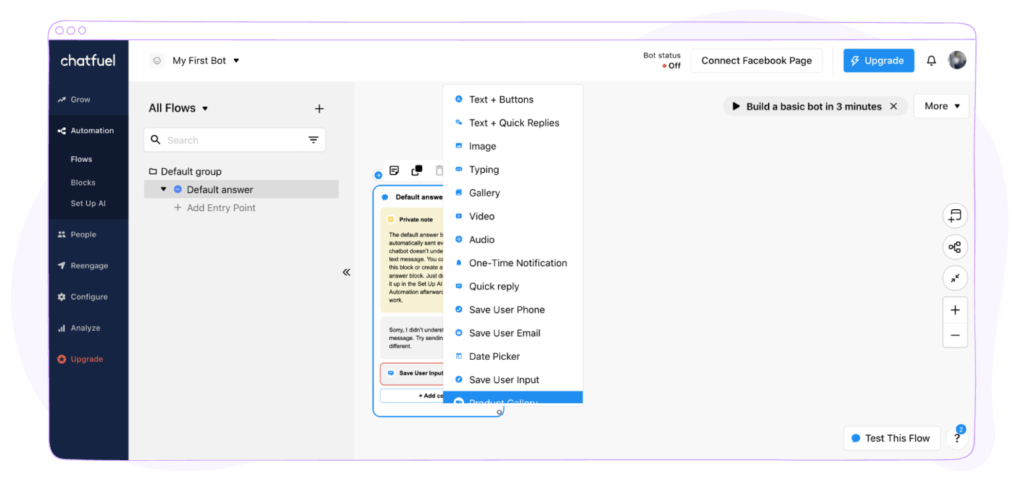
- Chatfuel is designed for non-technical users and says most businesses can set it up in under 15 minutes.
- It can answer DMs, comments, and story replies across Instagram, WhatsApp, and Facebook.
- Key features include AI replies, booking management, calendar reminders, CRM with contact history, daily briefings, and business recommendations.
- Chatfuel’s current pricing page lists one main plan at $69/month, with unlimited contacts and a 7-day free trial.
Related article: Top 10 Social Media Scheduler Tools in 2021
2. ManyChat
Manychat is a no-code automation platform for creators, brands, and businesses that want to automate conversations across social messaging channels. In 2026, it supports automations for Instagram, TikTok, Facebook Messenger, WhatsApp, Telegram, SMS, and email, depending on the plan.
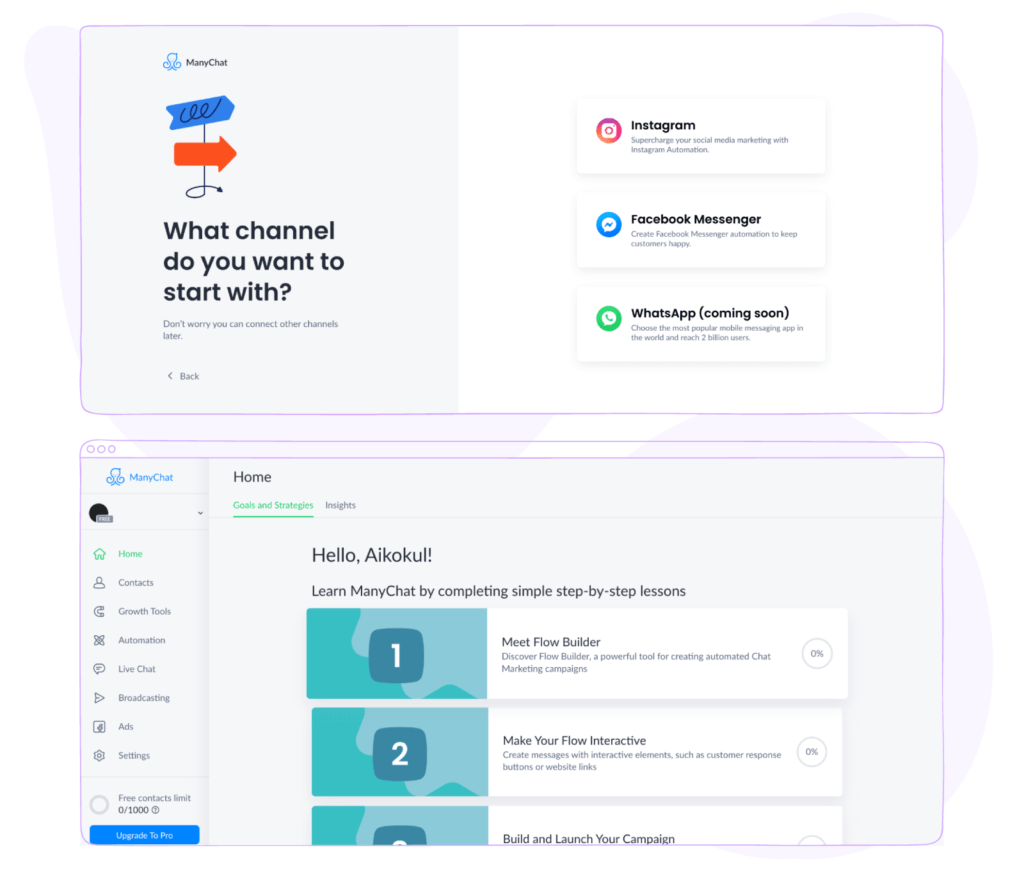
- Manychat’s free plan includes 25 Active Contacts per month, 1 user, basic automations, a basic unified inbox, and up to 2 eligible channels.
- Paid plans start from $14/month for Essential and $29/month for Pro. The Pro plan lets users connect up to 3 channels and includes unlimited automations, broadcasts, AI-powered conversations, custom inbox labels and rules, integrations, and API access.
- Manychat integrates with tools such as Google Sheets, Mailchimp, ActiveCampaign, HubSpot CRM, Klaviyo, Zapier, ChatGPT, Claude, and DeepSeek.
- Users can preview automations before publishing them, either inside Manychat or directly in native apps like Messenger and Instagram.
Related article: Facebook dark posts demystified. How to create and use dark posts in 2022?
3. WANotifier
While Facebook Messenger dominates B2C messaging, Meta’s other giant, WhatsApp, often drives even higher conversion rates. WANotifier is a no-code chatbot and marketing automation platform built exclusively for the official WhatsApp Business API. It is a solid pick for businesses that want to capture leads and automate customer support right where their audience spends most of their time.
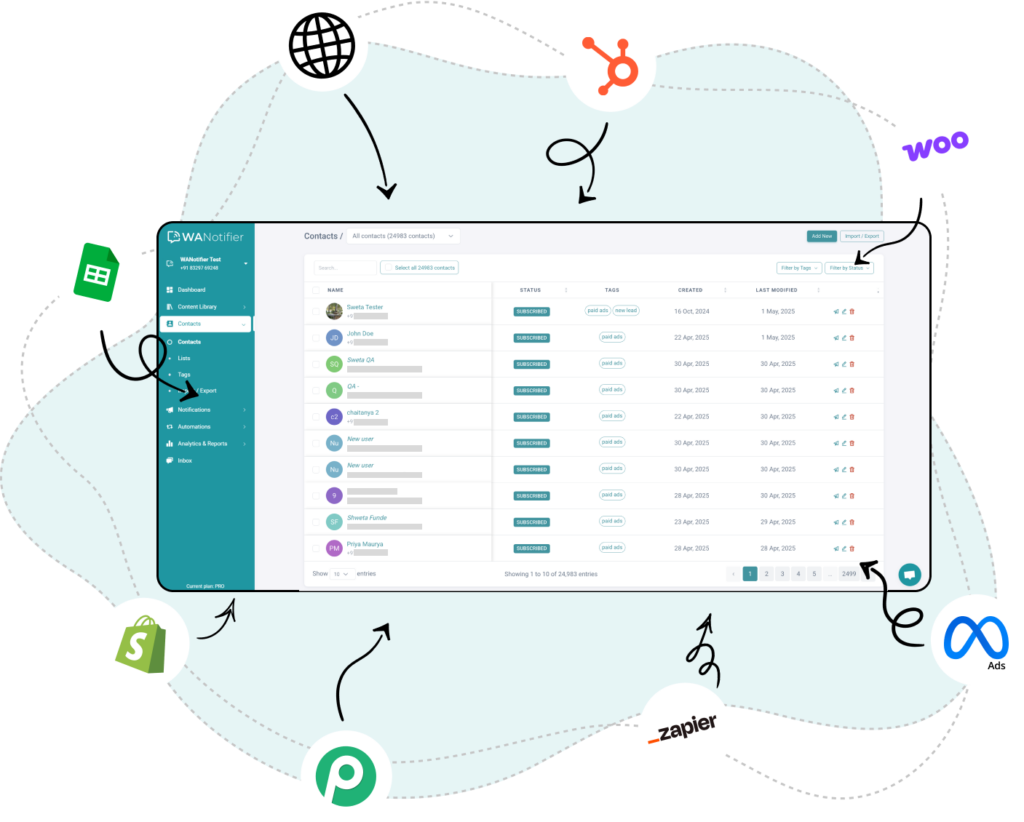
WANotifier offers a free trial to get started, and paid plans are priced at a flat monthly rate with Meta’s direct messaging fees billed separately on top.
- Built around Click to WhatsApp ads. When someone clicks your Facebook or Instagram ad, they land straight into a WhatsApp chat where the bot greets, qualifies, and saves their contact without a single form to fill out.
- Offers a no-code builder to set up welcome flows, quick replies, and transactional notifications like order updates or booking confirmations.
- As an official Meta Tech Partner, WANotifier charges 0% markup on API messaging fees, which keeps costs predictable and transparent as you scale.
- Connects with Google Sheets, Webhooks, and popular CRMs so your team can track incoming leads without switching between tools.
- Since the platform runs strictly on the official Meta API, businesses need to follow WhatsApp’s template approval process, which is a bit more structured compared to standard Messenger rules.
4. Customers.ai
MobileMonkey is now Customers.ai, and its chatbot product is no longer limited to Facebook Messenger. In 2026, its official chatbot tools cover Facebook Messenger, native web chat, SMS, and other messaging channels, making it more of a multi-channel chatbot and lead generation platform.
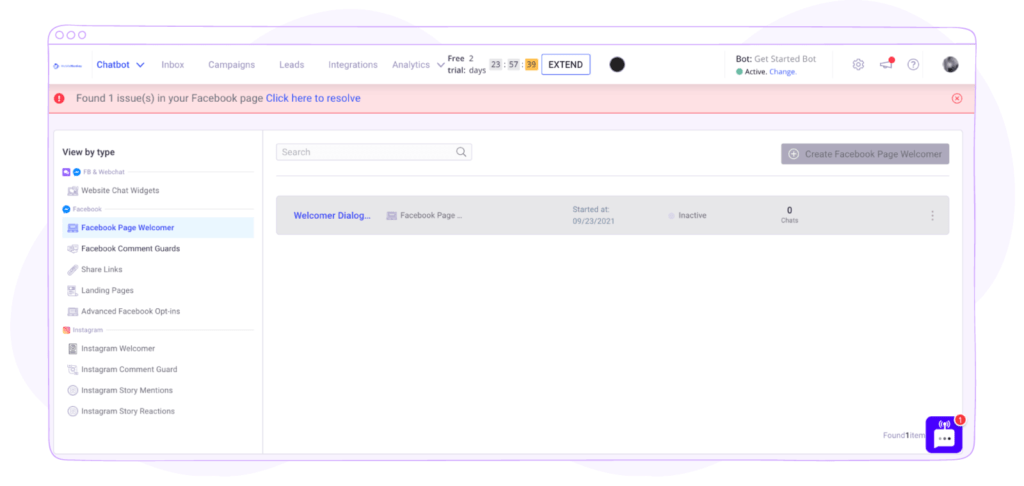
- Customers.ai’s OmniChat technology lets marketers build one chatbot funnel that works across Facebook Messenger, native web chat, and SMS.
- The platform can help businesses capture, qualify, and nurture leads, route website visitors to the right product or team, and manage conversations in one inbox.
- Its chatbot tools include website chatbots, Messenger website chat widgets, WordPress chatbot options, Q&A triggers, chat forms, audience segmentation, live chat takeover, and chatbot campaign analytics.
- Customers.ai says its advanced chatbot builder is no-code and supports SMS, web chat, Facebook Messenger, and more.
- Official MobileMonkey help docs list Pro, Pro Unicorn, and Team plans. The free plan has a 1,000 monthly send limit, while Pro has 2,000, Pro Unicorn has 6,500, and Team has 100,000.
- The public chatbot pricing page lists a Free plan, WP-Pro at $49/year, Pro from $19/month, Pro Unicorn from $49/month, and Team from $129/month.
Conclusion
Chatbot constructor platforms are easy to use and offer advanced options for integrated marketing. The setup times are getting shorter, the user experience is becoming more intuitive, and the possibilities for bots are getting wider.
There is no need to code a chatbot. In addition to embedding chatbots to Facebook Messenger, you can connect bots to other platforms such as Shopify, Slack, Hubspot, MailChimp, Microsoft Teams using one platform.
As we noted, Facebook chatbots equip you with user data and allow you to analyze popular requests and customer feedback. Thus, a properly configured chatbot can become an indispensable assistant that satisfies user requests and drives new leads.
Mentioning lead generation, here is the “Top 6 LinkedIn features to boost lead generation.” Don’t miss out!