



Best time to post on Instagram in 2026: Real data based on +335k brand posts
Summarize this article via
The best time to post on Instagram in 2026 is the evening, roughly 8 PM to midnight in your audience’s time zone, with Sunday night as the most consistent window. That’s what we found after comparing 335,210 organic brand posts tracked in Sociality.io, published between August 2025 and July 2026, against each account’s own typical post.
Midday is where it gets interesting. More than half of brand posts go out between 9 AM and 5 PM, and those are the posts least likely to beat their account’s usual numbers.
This guide is for social media managers who want a posting schedule built on data rather than habit, plus a way to test it on their own account.
TL;DR
Short on time? These 3 numbers from Sociality.io’s own data, 335,210 organic Instagram posts published between August 2025 and July 2026, carry the whole study.
- Posts published between 8 PM and midnight beat their account’s typical post 52% of the time, against 48.7% for posts published between 9 AM and 5 PM.
- Sunday from 10 PM to midnight was the strongest window of the week, with 60.2% of posts beating their account’s typical post.
- The day matters less than the hour, since every day of the week landed between 48.5% and 51.4%.
- TL;DR
- What is the best time to post on Instagram?
- What is the best day to post on Instagram?
- Best time to post Reels on Instagram (and carousels and photos)
- Why “when people are online” and “when posts perform” are different questions
- Does posting time still matter on Instagram?
- How to find your own best time to post on Instagram
- How we analyzed 335,210 Instagram posts
- Wrapping up 👋
What is the best time to post on Instagram?
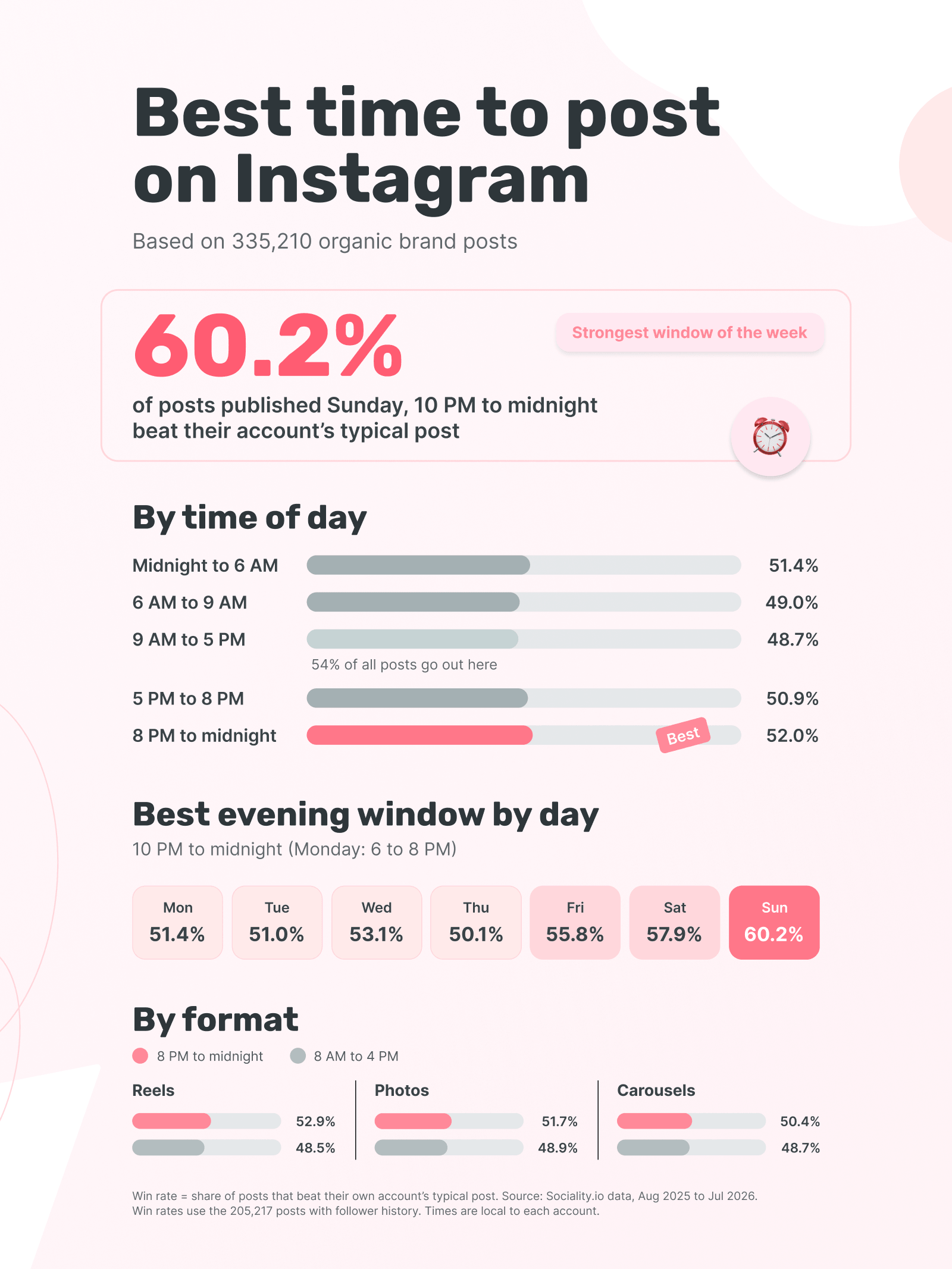
The best time to post on Instagram is between 8 PM and midnight, and 10 PM to midnight on Sundays is the single strongest window across the 335,210 brand posts in our Sociality.io dataset. We checked each post against the median post of the same account and format, measured as organic likes and comments per 1,000 followers. So a “win” simply means a post beat that brand’s usual.
More than half of brand posts go out between 9 AM and 5 PM, and those posts are the least likely to beat their account’s usual numbers. Evenings, by contrast, carry only about a tenth of all posts and still come out ahead on every day of the week. Here’s how each part of the day performed across all 7 days 👇
| Time of day (local) | Share of all posts | Posts that beat their account’s typical post |
|---|---|---|
| Midnight to 6 AM | 7.9% | 51.4% |
| 6 AM to 9 AM | 10.0% | 49.0% |
| 9 AM to 5 PM | 54.1% | 48.7% |
| 5 PM to 8 PM | 17.2% | 50.9% |
| 8 PM to midnight | 10.9% | 52.0% |
A 3-point gap won’t rescue a weak post. It does mean the default slot most brands pick is, on average, the least rewarding one.
The small hours scored well too. Only about 8% of posts went out between midnight and 6 AM, though, from far fewer accounts, so that window is something to test rather than a rule.
What is the best day to post on Instagram?
Sunday is the best day to post on Instagram in 12 months of Sociality.io data, although the margin between days is thin. Sunday posts beat their account’s typical post 51.4% of the time, while Tuesday sat at the bottom with 48.5%.
Weekends are also quieter for brands. Saturday and Sunday carried only 21.8% of all posts, and both beat every weekday on the share of winning posts. The table below shows each day’s overall result, its strongest evening window and its weakest window.
| Day | Posts that beat their account’s typical post | Strongest window after 6 PM | Weakest window |
|---|---|---|---|
| Monday | 49.3% | 6 PM to 8 PM (51.4%) | Midnight to 2 AM (46.4%) |
| Tuesday | 48.5% | 10 PM to midnight (51.0%) | Midnight to 2 AM (46.5%) |
| Wednesday | 49.6% | 10 PM to midnight (53.1%) | 10 AM to 12 PM (47.9%) |
| Thursday | 48.9% | 10 PM to midnight (50.1%) | 10 AM to 12 PM (47.3%) |
| Friday | 49.7% | 10 PM to midnight (55.8%) | 6 AM to 8 AM (47.2%) |
| Saturday | 50.6% | 10 PM to midnight (57.9%) | 12 PM to 2 PM (48.5%) |
| Sunday | 51.4% | 10 PM to midnight (60.2%) | 6 AM to 8 AM (47.3%) |
Sociality.io data: Posts published on Sunday between 10 PM and midnight beat their account’s typical post 60.2% of the time, the strongest result of all 84 day-and-time windows in 12 months of data.
Sociality.io analysis of 335,210 organic Instagram posts, August 2025 to July 2026
Sunday night is where the week peaks. 🌙 The late window gets stronger toward the weekend, from roughly a coin flip on Tuesday and Thursday to 6 winners in 10 on Sunday.
One pattern didn’t fit neatly. On Monday, Tuesday and Thursday, a 4 AM to 6 AM window edged past the evening, but it rests on far fewer accounts and on the time zones we trust least, so I’d test it before building a calendar around it.
Best time to post Reels on Instagram (and carousels and photos)
The best time to post Reels on Instagram is the evening as well, and Sunday from 8 PM to midnight was the standout, with 58.9% of Reels beating their account’s typical Reel. Every format was compared only with posts of the same format from the same account, so Reels were measured against Reels.
Reels were close to half of the dataset, 156,747 of the 335,210 posts we analyzed, and all 3 formats did better after 8 PM than during the working day.
| Format | Share of posts | Beat their typical post, 8 AM to 4 PM | Beat their typical post, 8 PM to midnight |
|---|---|---|---|
| Reels | 46.8% | 48.5% | 52.9% |
| Carousels | 26.7% | 48.7% | 50.4% |
| Photos | 26.5% | 48.9% | 51.7% |
Reels show the widest evening gap, probably because they’re the format people save for when they finally have a spare minute. Carousels are the odd one out, with their best stretch after midnight (53.6% between midnight and 6 AM), while photos posted in those same hours had their weakest result of the day at 48.0%.
If Reels carry your account, your Instagram Reels analytics will tell you whether watch time follows the same evening curve.
Why “when people are online” and “when posts perform” are different questions
Adding up engagement by hour mostly tells you when the most posts went out. Busy hours collect the most likes simply because that’s when the feed is fullest, which says little about whether your next post will do well there.
We asked a narrower question instead. Did this post do better than that same account’s typical post? Not only does comparing every post with its own account’s median take brand size and follower count out of the picture, it also stops busy hours from winning just by being busy. That’s why, after checking all 84 day-and-time windows, our answer points to the evening.
Your followers’ most active hours answer a third question entirely. Half of U.S. adults use Instagram, according to Pew Research Center’s 2025 survey, so some part of your audience is online at almost any hour. What your insights show is when people open the app, not when your post stands out.
The busiest hours are also when most brands publish. We can’t prove crowding causes the midday dip, but the slot with the most brand posts was the slot where posts most often fell short of their own baseline.
Does posting time still matter on Instagram?
Posting time still matters on Instagram, just less than your content does. Instagram’s own ranking explainer from 2023 lists when a post was shared among its Feed signals, right next to how popular the post is with likes, comments, shares and saves. Timing feeds that early reaction.
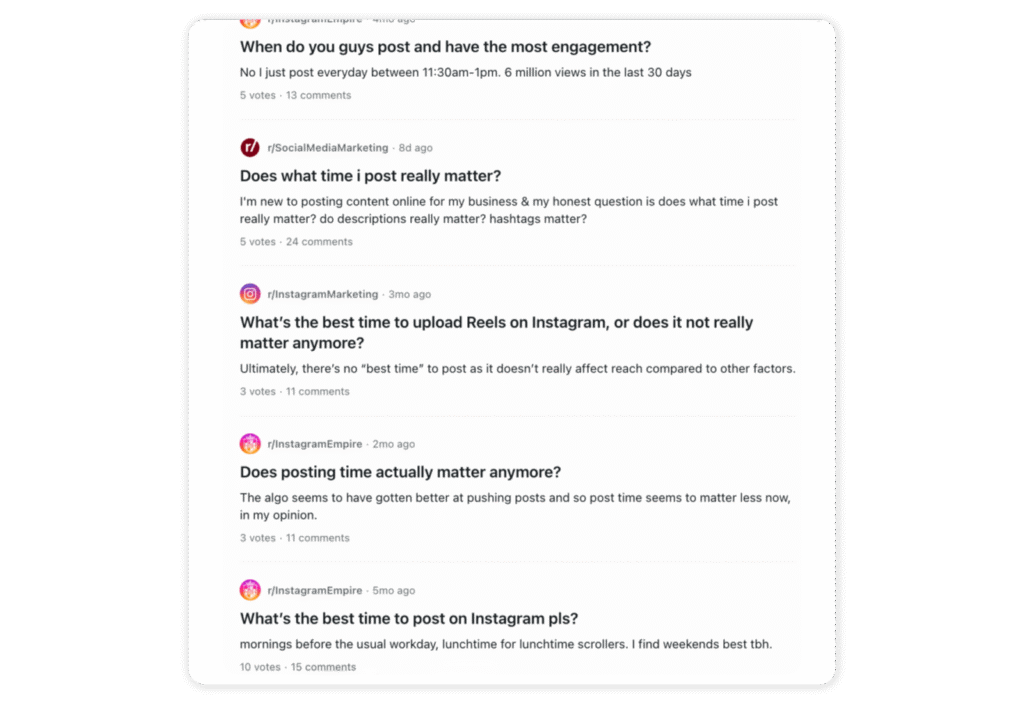
It’s also one of the questions that keeps coming back on Reddit. In the past few months alone, r/InstagramEmpire, r/InstagramMarketing and r/SocialMediaMarketing have all run threads asking some version of “Does posting time actually matter anymore?”, and the replies swing between fixed lunchtime schedules and “there’s no best time”. Our data, all 335,210 real brand posts of it, lands somewhere in between.
The size of the effect keeps it honest. Across the whole week, evening posts beat their baseline about 3 points more often than daytime posts, and even the best window of the week wins 6 times out of 10, not 10 out of 10.
Timing is a tiebreaker, not a strategy. ⏰ A strong Reel at 2 PM will still beat a forgettable one at 10 PM, because how the Instagram algorithm ranks posts leans on your audience’s activity, the post’s popularity and their history with your account, with the clock as one signal among thousands.
How to find your own best time to post on Instagram
Our data gives you a starting point, and your own account gives you the answer. These 4 steps take about a month.
- Step 1: Check when your followers are online. Instagram shows the times your followers are most active under Total followers in your insights, once you have at least 100 followers, for any timeframe within the past 90 days. In Sociality.io, the User activities graph under Audience insights in Analytics answers the same question.
- Step 2: Compare your posts with your own median. List your posts from the last 90 days with their publish time and organic engagement (our Instagram analytics guide covers where to find both), find the median, and mark each post as above or below it. Then group them into 2-hour windows and see which windows win most often.
- Step 3: Test one evening window for 4 weeks. Move 2 or 3 posts a week into an evening slot, keep the content mix close to normal, and compare how often they beat your median. It helps to schedule Instagram posts ahead so the test doesn’t depend on someone being online at 10 PM.
- Step 4: Watch when your competitors post. A social media competitor analysis shows which slots your competitors crowd and which of their posts actually land, so you can pick an evening window they leave open.
The hardest part of Step 3 is patience. Adam Mosseri, head of Instagram, gets at this in a 2025 interview with Build Your Tribe (from 9:17), where he advises against reading too much into one post and suggests looking for patterns across many instead. 4 weeks of evening posts is that pattern.
Let Sociality MCP do the Step 2 grouping
Step 2 is the tedious one by hand, and it’s exactly the kind of busywork AI features in a social media management SaaS should take off your plate. With Sociality MCP connected, ChatGPT, Claude or Gemini can pull your posts and do the grouping in one go. This is the prompt I used.
Pull every post from our Instagram account for the last 12 months. Group them by weekday and 2-hour posting window, and show which windows beat the account’s median organic engagement and how many posts each window is based on.
What happened when I ran Step 2 on Sociality.io’s own account 🪄
I ran the Step 2 prompt on Sociality.io’s own Instagram account through Sociality MCP on September 29, 2026, and the answer was humbling. All 16 posts from the past 12 months went out on weekdays between 1 PM and 4:20 PM UTC, which is 4 PM to 7:20 PM in Istanbul, and not one of them was a Reel. Very “data-driven.” 🙃
With every post in the same 3-hour band, there’s nothing to compare, and a median of 2 organic engagements per post would be too small to read anyway. That’s the real lesson of Step 2. You can’t find your best time if every post goes out in the same window, which is exactly why Step 3 exists.
How we analyzed 335,210 Instagram posts
The study covers public Instagram accounts that Sociality.io users track in Competitor Analysis, over 12 months of posts. Here’s the dataset at a glance.
| What we measured | Sociality.io dataset |
|---|---|
| Period | August 1, 2025 to July 31, 2026 |
| Posts scanned | 476,719 posts from 2,885 accounts with a clear time zone |
| Promoted posts removed | 111,467 (25% of eligible posts) |
| Too recent to measure | Posts younger than 14 days when the data was pulled |
| Organic posts analyzed | 335,210 posts from 2,658 accounts |
| Posts with follower history | 205,217 |
| Performance measure | Organic likes and comments per 1,000 followers, compared with the same account’s median post of the same format |
| Weighting | Every account counted equally |
| Minimum per 2-hour window | 50 posts from 15 accounts (all 84 day-and-time windows qualified) |
Posting times use the time zone set for each tracked account in Sociality.io, which is usually the time zone of the team doing the tracking rather than the brand’s home market. For 59% of accounts that’s UTC, so read the results as bands of the day rather than exact hours.
To check that, we reran the comparison on the 400 accounts tracked in Istanbul time, where local time is most reliable. The evening pattern held there too, with 59.3% of posts between 10 PM and midnight beating their account’s typical post, against 48.4% between 10 AM and 4 PM.
The limits are worth stating plainly. This is observational data, so it shows association, not cause. It counts likes and comments, not saves, shares or reach, and the accounts lean heavily toward UTC and Istanbul time zones, so they’re not a random sample of Instagram.
Wrapping up 👋
If you take one thing from 335,210 posts, make it this. The working day is where most brand posts go and where they most often underperform, while the evening, Sunday night above all, is where posts most often beat their own baseline.
Don’t rebuild your whole calendar overnight. Move a few posts into an evening window, give it 4 weeks, and let your own median decide.
If the spreadsheet is what’s stopping you, Sociality.io artificial intelligence can take care of that part. Sociality MCP, our social media MCP, runs the same median check on your own accounts and your competitors’ from inside ChatGPT, Claude, or Gemini, and you can basically connect Sociality MCP simply by asking AI to show it among its Plugins/Connectors. If you want to deeply understand how Sociality’s social media MCP works and what you can do with it, check out this full guide on it!
And if Instagram isn’t your only channel, our guide to the best times to post on social media covers the other platforms.
FAQ about the best time to post on Instagram