The quickest way to see a competitor’s promoted Instagram posts is Meta Ad Library, which lists every ad a brand is running right now, Instagram placements included. It won’t show you what they promoted last spring or how those posts performed, which is why most social media teams end up tracking competitors over time as part of their social media analytics report.
If you want the best possible ROI from your own ad spend, it helps to know which posts your competitors decided were worth paying for.
The short version
- An Instagram ad carries a Sponsored label, and its three-dot menu opens “Why am I seeing this ad?” on Feed, Stories and Reels.
- Meta Ad Library lists every ad running right now. Ads that ran in the EU or the UK stay searchable for a year, political and social issue ads for seven years.
- Your own boosts sit in Meta Business Suite under Insights, in the Ads tab, and in the Instagram app under Professional dashboard, Ad tools.
- In October 2026, 306 of 1,896 Instagram posts from 38 brand accounts (16.1%) ran as an ad at some point, and 29 of the 38 brands promoted at least one.
- On TikTok, the Commercial Content Library covers ads shown in the EEA, Switzerland and the UK and keeps them for a year after their last view.
How to tell if an Instagram post or Reel is boosted
A boosted post or Reel is an ordinary post that the account paid to show to more people, so it reaches some of them as an ad. When it does, Instagram marks it Sponsored under the account name, in Feed, Stories and Reels alike.
Two checks confirm it from your side:
- Tap the three dots on the post and open “Why am I seeing this ad?”, which Meta has updated across Instagram Feed, Stories and Reels. Since June 2026, Meta has also been rolling out “About this ad” in the same menu, though what you see can vary by region.
- Search the account in Meta Ad Library and look for the same creative among its active ads.
Don’t judge by the brand’s profile grid. The label belongs to the ad as it’s served to someone, so the same post opened from the profile can look like any other. In our October 2026 data, 306 brand posts sat on their profiles like everything else and had still run as ads.
Paid partnership is a different label. It marks branded content made with a business, not ad spend. Brands can, however, boost that content as partnership ads, and then it’s an ad like any other.
A match in Ad Library tells you the creative was advertised. It doesn’t tell you whether the brand pressed Boost in the app or built the campaign in Ads Manager, and it doesn’t tell you what they spent.
How to check if your own post is boosted
Your own boosts are easier to find, because Meta shows you the results:
- In the Instagram app, go to your profile, open the Professional dashboard and tap Ad tools, where you can create and review ads and view ad insights.
- On desktop, open Meta Business Suite, choose Insights in the left menu and then the Ads tab. It lists ads and boosted content created in Business Suite for your Facebook Page or Instagram profile, as long as you have access to them.
- If someone on your team built the campaign in Ads Manager instead of pressing Boost, its results stay in Ads Manager.
Still deciding whether a boost is worth the money at all? We’d read why boosting posts can cost you more than it saves before the next one.
Using Meta Ad Library to track your competitors’ promoted Instagram posts
We’ll start with Meta Ad Library, Meta’s free, searchable record of the ads running across Facebook, Instagram and its other apps. It began in May 2018 as an archive of US ads with political content and opened up to all active ads any Page is running in March 2019. For the wider picture of a rival’s Facebook ads, see our Facebook ads competitor analysis.
Here’s how to find a competitor’s promoted Instagram posts in it today:
- Open the Ad Library and set the location to the market you compete in. The country decides which ads you see.
- Switch the ad category to All ads. Depending on the link you arrive from, the page can open on political and issue ads instead.
- Type the brand’s name and pick its Page from the suggestions, so you get that advertiser’s ads rather than every ad that mentions the word.
- Open Filters and set Platform to Instagram. Active status, Media type, Language and Impressions by date narrow it further, which helps when you only want what ran before Black Friday, Christmas or another big date.
- Use Sort by to switch between Impressions (high to low) and Most recent, then open See ad details on any card.
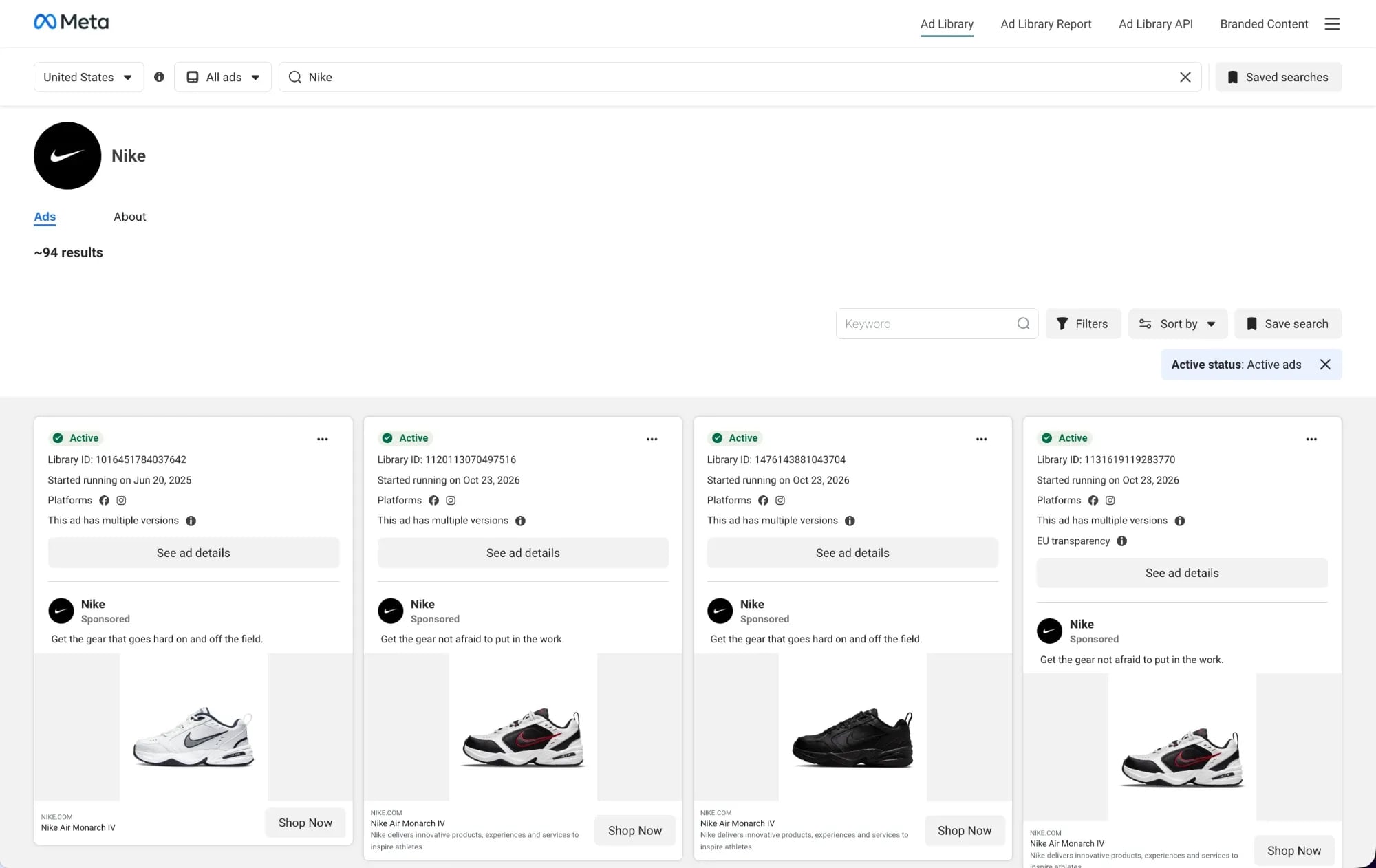
What an Ad Library card shows
Each Ad Library card shows whether the ad is Active, its Library ID, the date it Started running on and the platforms it runs on. Some also say “This ad has multiple versions”, meaning the brand is running several images, videos or captions under one ad. That shows you what they’re testing, but it isn’t a result, because Ad Library never says which version won. An ad that started months ago and is still running is the closest thing to a performance signal you’ll get here, since brands rarely keep paying for something that doesn’t work.
New ads show up within 24 hours of their first impression, so a check today catches yesterday’s launches. You’ll also have to remember to return to Ad Library every now and then so that you can stay updated on your competitors’ Instagram ad strategy. That’s no biggie if you can fit it into your schedule, but having automatic reports sent to your inbox gives you one less thing to do.
Meta Ad Library pros
- Free, and covers every ad a brand is running right now on Facebook and Instagram
- Has multiple filter options for refining results
- Shows different versions of an ad where applicable
- Shows how long the ad has been running, with a Library ID you can note down to find the same ad again
Meta Ad Library cons: what it won’t tell you
Outside the EU and the UK, Ad Library is a live view. It shows all the ads currently running, so an ad a competitor switched off last month drops out of sight, unless it was about social issues, elections or politics. Those stay for seven years, with spend and impressions in ranges.
Europe gets more history. The EU’s Digital Services Act (Article 39) makes very large platforms keep every ad until a year after it last ran, with who paid for it, when it ran, its main targeting parameters and how many people it reached. Meta keeps ads delivered to the UK for a year too, but it shows advertiser and payer details for EU ads only.
What you won’t get for an ordinary product ad, anywhere:
- How much the competitor spent on it
- Likes, comments or engagement rate
- Whether it started as a boosted post or an Ads Manager campaign
- More than one advertiser on the same screen, or a report you can send your team
Instagram’s own Competitive insights doesn’t fill the gap for most teams. It compares your account with up to 10 public accounts, ads included, but it comes with a paid Meta One plan that Meta was still testing with a limited group in late 2026.
How many brand posts get promoted on Instagram?
About one in six. We tracked 1,896 Instagram posts that 38 global brand accounts published from 1 to 31 October 2026, and 306 of them (16.1%) ran as an ad at some point. They’re well-known consumer brands we follow in Sociality.io, not a random sample of Instagram accounts, so read the numbers as a benchmark for big brands rather than for every business.
Promotion is common but uneven. Of the 38 brands, 29 (76%) promoted at least one October post, nine promoted none, and four put money behind half or more of everything they published. The median brand promoted 11.2% of its posts.
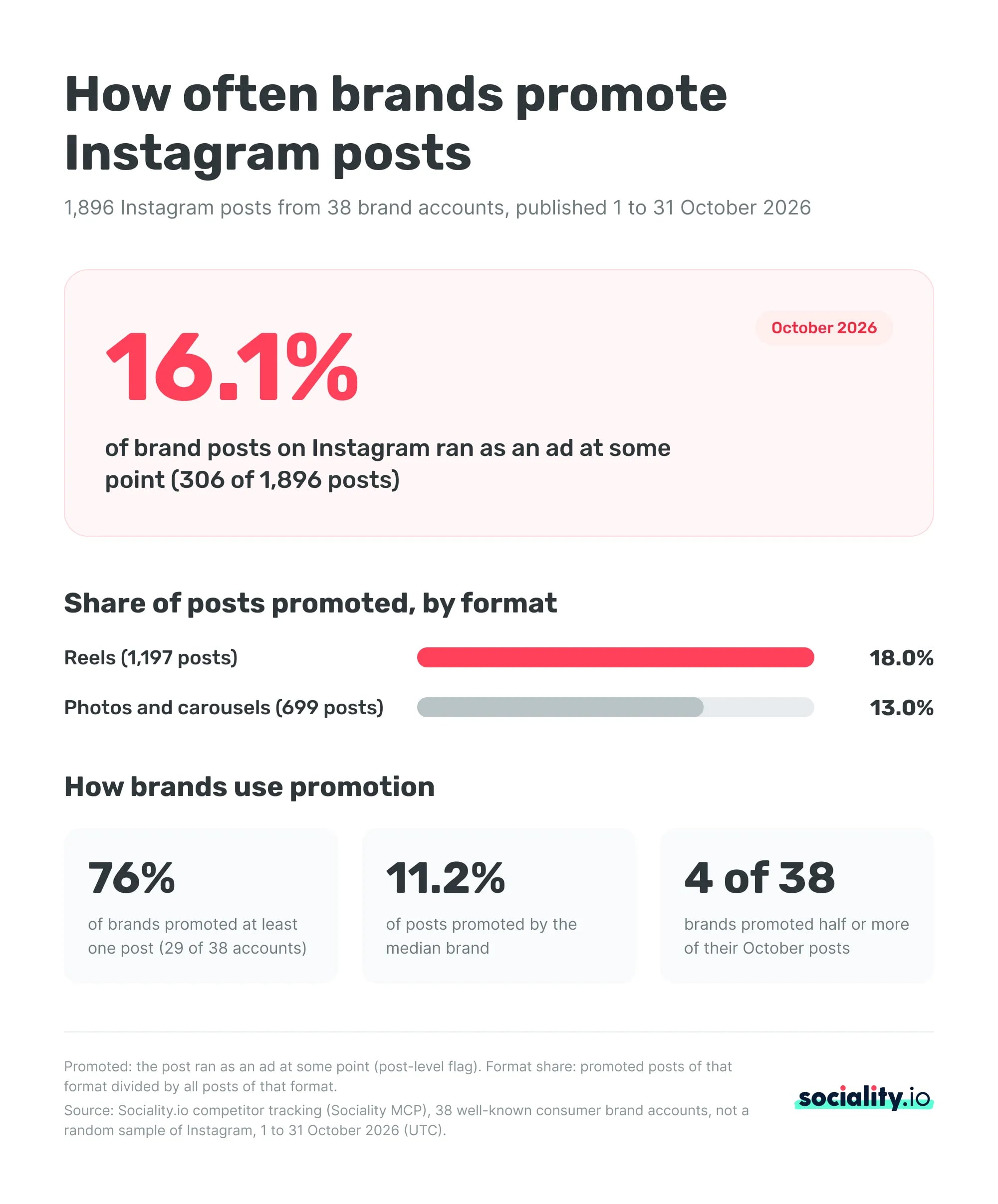
Reels were promoted most often: 18.0% of the 1,197 Reels ran as ads, against 13.0% of the 699 photos and carousels, which is a good reason to analyze competitor Reels beyond their view counts.
We pulled these numbers with Sociality MCP’s competitor posts tool, which returns each post with a promoted flag next to its likes and comments (split into paid and organic where Instagram reports them), so you can ask the same question about your own competitors in a chat.
Sociality MCP connects your social accounts to ChatGPT, Claude or Gemini, so you can ask about Instagram in plain language and get answers from your Sociality.io data. For example:
What are the top engaged posts of Redbull this month on Instagram?
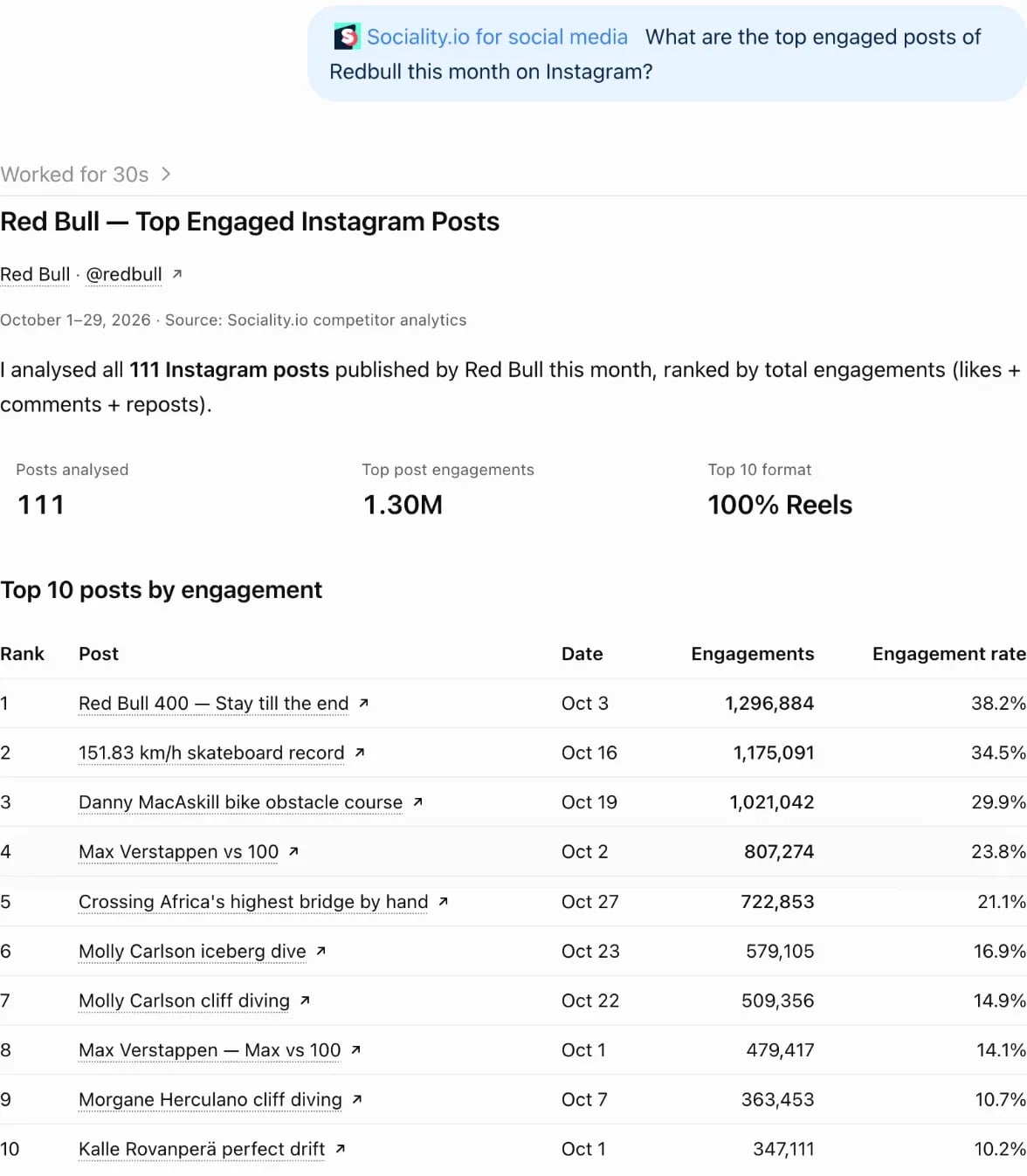
The answer comes back as a ranked table of the posts with their engagement and engagement rate, so you can see what works for a competitor without opening a single profile or exporting a spreadsheet.
Connect Sociality MCPFree to start: 1,000 credits, no credit card.
Why track competitors’ promoted Instagram posts?
Reason 1: To learn what works
If someone’s already discovered a strategy that works, what’s the point in learning it through trial and error?
By looking at your competitors’ promoted posts on Instagram, you can quickly identify what’s working for them. That can inform your own paid strategy.
The posts a competitor pays for are the ones it most wants your audience to see. In our October 2026 data, 29 of 38 brands put money behind at least one of their posts.
However, you have only so much ad spend to go around, plus you have ROI targets to hit. If you can learn from others in your space, you’ll optimize and budget your Instagram ads better and get more out of them.
Reason 2: To learn what not to do
If you’re tracking your competitors’ promoted posts and realize they’ve stopped running a certain ad after just a short while, chances are it was a dud.
Analyzing the ad can give you some clues as to why it didn’t work, which you can avoid for your brand’s promoted posts.
With metrics like the number of interactions and the engagement rate, which a competitor tracking tool adds and Ad Library doesn’t, you can be even more certain about the performance of each of your competitors’ promoted posts.
That can give you specific insights into why the post didn’t do so well, meaning you won’t have to lose any of your own ad budget to learn the lesson.
Reason 3: To differentiate your brand
It could be that you realize the need for your own promoted posts to have a voice of their own, different from the voice of your competitors.
Keeping an eye on your competitors’ promoted posts will serve you well here, too, as you’ll see how you can create promoted posts that stand out from your competitors’ ads, positioning you to win greater attention and engagement. If you’re looking to learn more about the benefits of competitive analysis and get a clearer general picture of it, our roundup of social media competitor analysis tools is a helpful resource.
For the organic side of the same comparison, here’s how to prepare an Instagram competitor analytics report in five minutes.
How to see a brand’s promoted TikTok videos
TikTok has its own ad library, but where you are decides how much of it you’ll see.
- The Commercial Content Library covers ads shown to people in the European Economic Area, Switzerland and the UK, paused and finished ones included, for a year after their last view. Each ad lists the advertiser, who paid for it, when it was first and last shown, an estimated range of unique users and a targeting summary. You don’t need a TikTok account to search it.
- Top Ads in TikTok Creative Center is a curated set of high-performing ads that advertisers have authorized for it. You search it by product or keyword and filter by region, industry and objective, not by advertiser, and logged-out visitors see only five ads.
In the app, paid ads carry a “Sponsored” or “Ad” label. Disclosed creator content gets its own labels: Promotional content when it promotes the creator’s own brand, Paid partnership when it’s for another business.
Then there’s Promote, TikTok’s in-app ad tool, which boosts a video the account has already posted as a paid ad. If your market sits outside the EEA, Switzerland and the UK, the library won’t show ads that ran only there, so the label on the video is your best clue.
Closing thoughts
Before you start using your ad spend, seeing what Instagram posts your competitors have chosen to promote can give you some perspectives on the kinds of posts that are likely to give you the best ROI, and those that aren’t.
Making this a permanent part of your competitive benchmarking is a sure way to spot opportunities for getting ahead of other brands competing for your audience’s attention. Ad Library is fine for spot checks, but a running record of which competitor posts were promoted, and how they did, needs those accounts tracked month after month.
Promoted Instagram posts FAQs
Which tool shows which competitor Instagram posts were promoted?
Meta Ad Library shows the ads a brand is running today, but not which of its posts ran as ads last month or how they performed. Sociality.io tracks competitors’ Instagram posts and marks the ones that were promoted, with likes and engagement next to your own accounts. If you work in ChatGPT or Claude, Sociality MCP returns the same promoted flag in a chat.
Can you tell if someone boosted their Instagram post?
Partly. If the post reaches you as an ad, it carries a Sponsored label, and its three-dot menu opens “Why am I seeing this ad?”. The same post opened from the account’s profile grid can look like any other post, though. To confirm, search the account in Meta Ad Library and look for that creative among its active ads.
How do I know if an Instagram Reel is boosted?
A boosted Reel shows Sponsored under the account name when it plays as an ad in your Reels feed, and its three-dot menu includes “Why am I seeing this ad?”. For a competitor’s Reel, check the brand’s active ads in Meta Ad Library. For your own Reels, open the Professional dashboard and tap Ad tools to review your ads and their insights.
Where can I see my own boosted posts on Instagram?
In the Instagram app, go to your profile, open the Professional dashboard and tap Ad tools to review your ads and their insights. On desktop, Meta Business Suite lists boosts made there under Insights, in the Ads tab, for the Pages and profiles you can access. Campaigns someone built in Ads Manager keep their results in Ads Manager.
Does “Paid partnership” mean a post was boosted?
No. Paid partnership marks branded content, a post made in partnership with a business, and on its own it says nothing about ad spend. Brands can boost that content as partnership ads, though, and then it runs as an ad. To check, look for the post among the brand’s ads in Meta Ad Library, or use the library’s Branded content search.
What is a promoted post on Instagram?
A promoted post is an ordinary Instagram post or Reel that an account paid to show to more people, usually with the Boost button in the app. While the promotion runs, the people it reaches see it with a Sponsored label. Boosted post and promoted post mean the same thing here.
Can I see a competitor’s old Instagram ads?
Only in some places. Meta Ad Library keeps ads that ran in the EU or the UK for a year, and ads about social issues, elections or politics for seven years. Everywhere else it lists what’s running now, so an ad a competitor stopped last month drops out of view. To keep a record, check regularly or track the account in a tool.
Can Meta Ad Library show how much a competitor spends?
Not for ordinary product ads. Meta shows spend, in ranges, only for ads about social issues, elections or politics. For ads delivered in the EU it adds who paid, when the ad ran, the targeting and the reach, but still no spend. For a cost benchmark, rely on your own campaign results rather than guessing from a rival’s ads.